
Use the footage you have
Start with standard video. No mandatory wearables or specialist camera system for the video-analysis workflow.
Quantum Physical Intelligence
QuInMotion
Turn everyday sports video into a virtual movement laboratory. Bring quantum-inspired methods, physics, and computer vision to the way you understand movement.
Quantum & Classical Physics-Based Sports Analytics
Performance. Condition. Health.
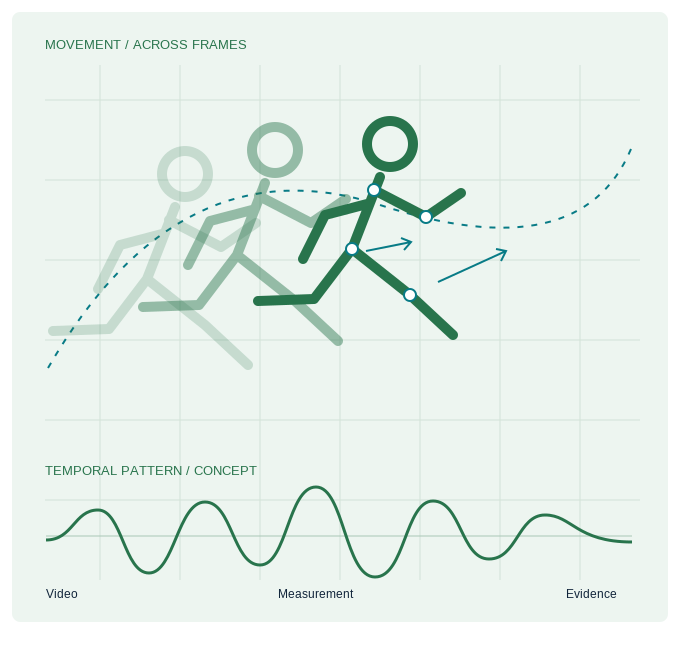
From a familiar video to a closer look at movement. Explore the workflow with the QuInMotion team.
Why QuInMotion?
Standard video becomes measurable movement intelligence. Game and training footage captures more than a replay. QuInMotion adds a repeatable analytical layer, helping teams turn that existing footage into interpretable movement intelligence.
Start with standard video. No mandatory wearables or specialist camera system for the video-analysis workflow.
Review frame-level measurements and patterns over time alongside the original and processed footage.
Explore motion, intensity, events, structure, rhythm, lighting, and 3D body pose. Physics-based and quantum-inspired methods connect these perspectives.
Analyze locally on your desktop. Routine processing does not require uploading sensitive footage to a cloud service.
Performance
Examine consistency, technique, apparent motion speed, and rhythm. Compare movement against baseline or reference footage to guide more focused feedback.
Condition
Review session-to-session changes in intensity, symmetry, and temporal patterns. These observations can inform fatigue and load discussions alongside professional judgment.
Health & rehabilitation
Track movement progression and compare with pre-injury baselines. Give qualified staff additional evidence for rehabilitation review and return-to-play discussions.
QuInMotion provides movement analytics and decision-support information. It does not independently provide medical diagnosis or determine medical readiness to return to play.
The computational foundation
Multiple representations of movement. One practical purpose: make the underlying patterns easier to examine.
QuInMotion brings classical and quantum-inspired mathematical methods together with computer vision, signal analysis, and biomechanical interpretation. The seven analytical studies reveal different properties of the same footage, from apparent motion and repeating patterns to three-dimensional body movement.
Quantum-enabled. Not quantum-dependent. The product runs locally on a desktop. Its quantum-inspired foundation describes a computational approach; it is not a claim of quantum-hardware execution or demonstrated quantum advantage.
Explore QuGradient’s research foundation ↗Start with the question you want to investigate. Open the technical details for the measurements and principles behind each study.
Track movement, trajectories, apparent speed and acceleration profiles, and directional motion. Connect technique analysis with tactical and spatial awareness.
Study sprinting mechanics, joint and limb motion, form consistency, and postural stability. Off-ball movement, defensive pressure, and group synchronization extend the analysis to team tactics. Flow Magnitude (pixels/frame), Direction (0–360°), and Motion Coherency (0–1) remain documented outputs. Real-world speed and acceleration interpretation depends on calibration, footage quality, and settings.
Explore intensity, rapid energy changes, instantaneous activity detection, and segmentation of active motion regions. Build movement profiles for technique, fatigue, and load review.
Applications include kinematic efficiency, rotational and release/contact behavior, running economy, asymmetry, compensation patterns, and changes under fatigue. These observations support injury-risk review and staged return-to-play assessment by qualified staff. Automated scouting and player profiling support quantitative comparison, not validated predictions of professional success. Motion History Image layers frame changes over time; advanced mechanical-energy interpretation remains on the development roadmap where not implemented.
Use software-based event analysis to examine rapid movement, micro-movement, and precise motion timing through meaningful pixel-level brightness changes.
The documented scope includes real-time action and gesture recognition, high-velocity kinematics, fatigue and injury-risk review, gaze tracking, and neuromorphic face analysis. Event-like temporal representations can make timing easier to inspect; effective temporal-resolution enhancement does not recover information absent from the source video. No specialized neuromorphic camera is required. Event Density, Positive-to-Negative Ratio, Mean, and Max remain documented outputs. Confirm advanced recognition and gaze/face availability for your release; these signals do not establish cognitive or medical diagnoses.
Study posture, orientation, trajectories, and fine structural changes. Explore image-derived indicators associated with visible contraction, muscle tension, or stiffness.
Biomechanical and posture review uses edges, gradients, and spatial patterns. Subtle, rapid surface changes may be associated with muscular contractions, while trajectory visualization supports player movement mapping. These are image-derived indicators of visible surface or structural changes, not direct measurements of internal muscle physiology. Texture Score, Texture Entropy, Dominant Orientation, Orientation Coherence, Mean Gradient Magnitude, and Contraction Areas are documented output fields.
Identify cyclic patterns, quantify movement frequency, and examine irregularities in repetitive motion. Explore performance, rehabilitation, and tactical skill patterns.
Examples include stride and stroke rate, cadence, left/right frequency comparison, tremor or instability signals, movement efficiency, and repeated skill rhythms. Anomalies are analytical observations for professional review, not diagnoses or independent return-to-play clearance. Dominant Frequency describes spatial patterns; Cycles per Second describes temporal repetition in Hz. Amplitude Spectrum and Spectral Entropy describe signal distribution.
Use shadow-motion spatial cues, cover-shadow analysis, and environmental lighting information to support tracking integrity, tactics, and posture review.
Applications include passing-lane evaluation, defensive spacing, player segmentation, shadow removal, and lighting-aware biomechanical interpretation. Venue and visibility analysis examines glare, lighting interference, and conditions relevant to cognitive-load discussions without inferring a causal medical conclusion or directly measuring cognitive load. Shadow Area, Moving Shadow, Shadow Direction, and V Diff Mean remain documented outputs. Confirm advanced venue-analysis scope for the current release.
Reconstruct athlete movement in three dimensions from standard video. Examine rotations, depth, alignment, and movement across multiple planes.
The documented model supports full-body kinematic analysis through joint angles, segment velocities, and center-of-mass trajectory. Applications span technique optimization, multi-plane asymmetry and joint-loading-pattern review, rehabilitation progression, and objective performance judging. Estimates support expert assessment; no lab-equivalent accuracy, diagnostic clearance, or official scoring certification is claimed. A model-specific CSV schema is not yet supplied.
The seven-model architecture is documented in the latest product overview. Advanced workflows are described as analytical support; confirm current-release availability and suitability with the team.
3D Athlete Pose Analysis
Reconstruct athlete movement from standard video. A markerless, three-dimensional representation helps teams examine rotations, depth, alignment, and multi-plane technique beyond a single flat view.
Examine spatial alignment and subtle rotations to support more precise feedback on form and execution.
Explore full-body kinematics through joint angles, segment velocities, and center-of-mass trajectory.
Review asymmetries, joint-loading patterns, and progression across planes of motion as evidence for qualified professionals.
Use repeatable quantitative movement evidence to complement human assessment in technique-graded or judged sports.
Video-derived estimates support expert judgment. They do not establish lab-equivalent accuracy, medical clearance, or official judging certification. Confirm current-release scope with the team.
The documented image and signal-analysis models produce structured CSV outputs. Output types vary by model; the new 3D pose capability does not yet have a supplied CSV schema. Rows typically correspond to a frame or short time window, making the outputs available for review, comparison, and further analysis.
| Analysis | Measurement | What it describes | Unit / range |
|---|---|---|---|
| Optical flow | Flow Magnitude | Apparent pixel displacement between frames | pixels / frame |
| Optical flow | Direction · Motion Coherency | Motion heading and consistency among neighboring pixels | 0–360° · 0–1 |
| Neuromorphic | Event Density | Brightness-change events within a space-time window | events / window |
| Neuromorphic | Positive-to-Negative Ratio · Mean · Max | Event polarity balance and average / peak event rates | ratio · events / interval |
| Texture & gradient | Texture Entropy · Dominant Orientation | Pattern complexity and predominant edge direction | relative · 0–180° |
| Texture & gradient | Orientation Coherence · Mean Gradient Magnitude | Directional agreement and average edge strength | 0–1 · relative |
| Frequency | Dominant Frequency · Cycles per Second | Strongest spatial pattern and temporal repetition rate | spatial cycles · Hz |
| Shadow & illumination | Shadow Area · V Diff Mean | Shadow extent and average brightness difference | pixels · brightness difference |
Image-space motion is not automatically real-world speed. Relative indices are best compared within a session. Interpretation depends on video quality, calibration, and analysis settings.
A desktop workflow that connects observation with structured outputs.
Start with game, training, or movement footage.
Identify a sequence, comparison, and analytical objective.
Choose from optical flow, motion energy, neuromorphic, texture and gradient, frequency, shadow and illumination, or 3D athlete pose analysis. Processing runs locally.
Inspect processed views, frame-level measurements, temporal behavior, and movement patterns.
Compare sessions, baselines, sequences, or reference footage where supported.
Export supported measurements and analysis packages. Output formats vary by model.
QuInMotion combines standard-video input, complementary analytical methods, local processing, and exportable evidence. Compare the workflow that fits your needs.
| Workflow | QuInMotion | Traditional video review | Wearable / sensor systems | Lab biomechanics | Cloud-first video analytics |
|---|---|---|---|---|---|
| Starting point | Standard video | Recorded footage | Sensor recordings; varies | Configured capture setup; varies | Video; requirements vary |
| Processing & control | Offline-first desktop | Varies by product | Varies by product | Varies by system | Cloud-centered; local options vary |
| Analytical approach | Seven complementary models, including 3D athlete pose | Replay and observation; tools vary | Sensor-specific signals; varies | Protocol and equipment dependent | Model and product dependent |
| Structured data | CSV by model; frames / time windows | Varies by product | Varies by product | Varies by system | Varies by product |
| Multi-model movement analysis | Seven analytical models | Varies by solution | Varies by solution | Varies by solution | Varies by solution |
| Event-based neuromorphic analysis | Software-based event interpretation | Varies by solution | Varies by solution | Varies by solution | Varies by solution |
| Frequency-domain analysis | Cyclic patterns and irregularities | Varies by solution | Varies by solution | Varies by solution | Varies by solution |
| Shadow / illumination analysis | Spatial cues and tracking integrity | Varies by solution | Varies by solution | Varies by solution | Varies by solution |
| 3D pose analysis | Spatial technique and kinematics | Varies by solution | Varies by solution | Varies by solution | Varies by solution |
| Physics-oriented analysis | Image, motion, and signal representations | Varies by solution | Varies by solution | Varies by solution | Varies by solution |
| Quantum-inspired foundation | Advanced-computation architecture | Varies by solution | Varies by solution | Varies by solution | Varies by solution |
| Offline / local processing | Desktop processing | Varies by solution | Varies by solution | Varies by solution | Varies by solution |
Built for local analysis
Desktop deployment is part of the product’s value.
Keep sensitive athlete footage within your environment while performing routine analysis. An offline-first workflow gives professional teams, universities, research programs, and performance organizations control over how video is processed and retained.
Sport-agnostic tools for professional organizations and advanced individual practitioners.
Complement visual review with repeatable observations for technique feedback.
Compare movement patterns and changes across sessions.
Examine quantitative and temporal measurements in greater depth.
Build evidence for longitudinal movement review with qualified staff.
Export structured data and study multiple representations of motion.
Study off-ball movement, defensive pressure, synchronization, passing lanes, and skill rhythms. Compare quantitative player profiles as analytical support, without treating them as forecasts of professional success.
QuInMotion is an offline-first desktop sports analytics application developed by QuGradient that analyzes standard video using seven complementary models. The toolkit includes side-by-side review, session analysis, frame-level and temporal measurements, and supported structured exports. The seventh model adds 3D athlete pose and documented full-body kinematics.
Discuss the current release and your footage with the team to establish a suitable evaluation workflow.
Advanced force/velocity, torque, and deeper energy-based interpretation remain on the roadmap where not fully implemented. Joint angles, segment velocities, and center-of-mass trajectory are now documented under 3D Athlete Pose Analysis. Release-specific availability of advanced recognition, gaze/face, and venue workflows should be confirmed with the team.
These are development directions, not promises of production-ready clinical or biomechanical measurements in every release.
Before you begin
QuInMotion is QuGradient’s desktop sports video analytics product. It turns standard game and training footage into interpretable movement intelligence through multiple image, physics, and signal-analysis methods.
It is an offline-first desktop application. Routine video analysis runs locally on your computer rather than requiring a cloud video-processing workflow.
The video-analysis workflow starts with standard footage and does not require mandatory wearables or a specialized third-party camera system. Footage quality and calibration still affect interpretation.
The approach is sport-agnostic and is intended for activities involving movement. Discuss your footage, activity, and analytical question with the team to assess suitability.
The product combines classical and quantum-inspired mathematical ideas with computer vision, signal processing, and biomechanical interpretation. This describes its computational foundation, not proven quantum advantage or current quantum-hardware execution.
Yes. Its offline-first desktop architecture keeps routine processing within your environment, supporting control over sensitive performance footage.
Documented outputs include optical-flow magnitude and direction, event density and rates, texture and orientation measures, frequency measurements, and shadow attributes. CSV files organize measurements by analysis model, typically by frame or short time window.
It can provide movement evidence and session comparisons for qualified professionals. It does not independently provide medical diagnosis or determine medical readiness to return to play.
Advanced energy-based capabilities, including deeper force/velocity and torque interpretation, remain in development where not implemented. The latest overview documents joint angles, segment velocities, and center-of-mass trajectory under 3D Athlete Pose Analysis. Confirm release-specific availability, especially advanced recognition, gaze/face, and venue workflows, with the team.
Use the access form to request a demonstration, product access, an organizational evaluation, research use, or a partnership. The team will follow up about suitable next steps.
Optical Flow, Motion Energy, Event-Based Neuromorphic Analysis, Texture & Gradient Analysis, Frequency-Domain Analysis, Shadow & Illumination Analysis, and 3D Athlete Pose Analysis.
Yes. The documented seventh model reconstructs a three-dimensional representation of body movement from standard video, supporting spatial technique review, biomechanics, rehabilitation assessment, and quantitative evidence for judged sports. Confirm the current release against your use case.
The 3D pose model is documented to support joint angles, segment velocities, and center-of-mass trajectory. These are video-derived estimates whose interpretation depends on footage and model assumptions. No 3D-pose CSV field specification has been supplied.
Optical flow supports off-ball movement, defensive pressure, and group synchronization. Shadow analysis adds cover-shadow and passing-lane perspectives; frequency analysis examines tactical skill rhythms. Movement profiling can support scouting comparisons without predicting future professional success.
QuInMotion / Access
Request QuInMotion Access
Tell us about your organization and what you want to analyze. The QuGradient team can discuss a demonstration, product access, an evaluation, research use, or a partnership.
Please do not include athlete health records or confidential footage. No video upload is required.
Contact the QuGradient team about QuInMotion ↗QuInMotion is a QuGradient product within the Quantum Physical Intelligence portfolio. Explore all QuGradient products ↗